Mean- Add up all values and divide it by how many values there are.
Median- The middle number in a set of ordered values, might be the mean of 2 middle values.
Mode- The value that shows up the most.
Range- Positive difference between largest and smallest values.
Outlier- Values that are too big or too small compared to the other values.
Eg. 18, 19, 79, 17, 20, 12
Mean = 12, 17, 18, 19, 20, 79
12+17+18+19+20+79 =27.5
6
Median = 12, 17, 18, 19, 20, 79 =18.5
Mode = 12, 17, 18, 19, 20, 79 = No Mode
Range = 12, 17, 18, 19, 20, 79
79+12=91
Outlier = 12, 17, 18, 19, 20, 79 = 79
Red = ordered from least to greatest
Blue = Answer
Showing posts with label DJessica. Show all posts
Showing posts with label DJessica. Show all posts
Wednesday, June 13, 2012

Divisibility Rules
1- all numbers
2- even numbers
3- sum of the digits is divisible by 3
4- divisible by 2 twice
5- ends in a 0 or 5
6- divisible by 2 or 3
8- divisible by 2 thrice
9- sum of the digits is divisible by 9
10- ends in 0
Here is a link if you are still having trouble with the divisibility rules:
http://math.about.com/library/bldivide.htm
2- even numbers
3- sum of the digits is divisible by 3
4- divisible by 2 twice
5- ends in a 0 or 5
6- divisible by 2 or 3
8- divisible by 2 thrice
9- sum of the digits is divisible by 9
10- ends in 0
Here is a link if you are still having trouble with the divisibility rules:
http://math.about.com/library/bldivide.htm
Probability (Exam Notes)
Always remember that probability = Favourable outcomes
Possible outcomes
Experimental probability- actually doing the trials.
Theoretical probability- what you expect to happen.
Eg.
P (heads and rolling a 4 with a regular die)
Possible outcomes
Experimental probability- actually doing the trials.
Theoretical probability- what you expect to happen.
Eg.
P (heads and rolling a 4 with a regular die)
 |
| Since there is 12 possible outcomes the experimental probability is 1 or 1:12 or 0.83% 12 |
Exam Notes
Perpendicular Bisector, Perpendicular, Parallel Lines, Intersecting:
Perpendicular Bisector- a line that bisects a different line segment into 2 equal parts.
Perpendicular- 2 lines that meet at a 90 degree angle.
Parallel Lines- 2 lines on the same plane that never meet.
Intersecting- 2 lines that intersect or cross at any point.
Here is a picture to show you what a perpendicular bisector, perpendicular, parallel lines and intersecting is:

Perpendicular Bisector- a line that bisects a different line segment into 2 equal parts.
Perpendicular- 2 lines that meet at a 90 degree angle.
Parallel Lines- 2 lines on the same plane that never meet.
Intersecting- 2 lines that intersect or cross at any point.
Here is a picture to show you what a perpendicular bisector, perpendicular, parallel lines and intersecting is:

Exam Review!
Transformations:
Translation- slide along a straight line.
Rotation- turn about a fixed point.
Reflection- mirror image.
*Know how to do and describe each of them!*
Translation- slide along a straight line.
Rotation- turn about a fixed point.
Reflection- mirror image.
*Know how to do and describe each of them!*
Sunday, February 12, 2012

Thursday, February 9, 2012
Today's BEDMAS question.
1) Follow the steps.

Is there any brackets, no.
Is there any exponents, yes. Go from left to right.

So you do the exponents 8x8=64
Then the rest stays the same.

Then you do the other exponents which is 2x2=4
Then the rest stays the same.

Next you do the division.
64/16=4


Is there any brackets, no.
Is there any exponents, yes. Go from left to right.

So you do the exponents 8x8=64
Then the rest stays the same.

Then you do the other exponents which is 2x2=4
Then the rest stays the same.

Next you do the division.
64/16=4

Then you do the subtraction.
4-4=0
So the answer is 0.
Value's, Constant's and Numerical Coefficient

Solving a question using variables and expressions
A group of students are talking. 2 friends leave the group. Write an expression for the number of students in the group after 2 leave.
1) Well since you don't know how many students there were in the whole group then you use a variable, which in this case we could use an "S" to stand for students.
2) Then you have to subtract 2, because 2 people left the group which is called an expression.
So the answer would be S-2.
1) Well since you don't know how many students there were in the whole group then you use a variable, which in this case we could use an "S" to stand for students.
2) Then you have to subtract 2, because 2 people left the group which is called an expression.
So the answer would be S-2.
Variable's and Expressions
What is a variable?
A variable is a letter that represents an unknown number.
eg. X, A, N.
What is an expression?
An expression is any single number or variable or combination of operations ( Subtraction, addition, multiplication and division) involving numbers and variables.
eg. 5, n, 8t, x+1, 2y-7.
Here is a link to help you if you are still having troubles with variables and expressions:
http://http://www.freemathhelp.com/Lessons/PreAlgebra_Variables_and_Expressions_BB.htm
A variable is a letter that represents an unknown number.
eg. X, A, N.
What is an expression?
An expression is any single number or variable or combination of operations ( Subtraction, addition, multiplication and division) involving numbers and variables.
eg. 5, n, 8t, x+1, 2y-7.
Here is a link to help you if you are still having troubles with variables and expressions:
http://http://www.freemathhelp.com/Lessons/PreAlgebra_Variables_and_Expressions_BB.htm
Sunday, February 5, 2012
My answer to the quiz question
If the quiz was out of 14 and I only got 3 questions wrong then why did I get a c?
Well my answer is:
You don't know if every question was worth 1 mark.
So if he missed 3 questions then that would be 11 out of 14 which is 78%.
Then if the 3 questions that he missed were worth 5 marks all together for example 2 questions were each worth 2 marks and then the other one is just worth 1 mark then that is already 5 marks taken off. So 9 out of 14 is 64%. This is why I think he got a c on his quiz.
Monday, December 12, 2011
Adding fractions with unlike denominators
Steps on how to do adding fractions with unlike denominators.
1) You have two fractions.
eg.

1) You have two fractions.
eg.

2) Now you find the multiples of the two denominators until you find a L.C.M. (lowest common multiple).
eg.
4- 4, 8, 12, 16, 20
6- 6, 12, 18, 24, 30
So the L.C.M. is 12.
3) Next you make an equivalent fraction.
How do you get from 4 to 12 and how to you get from 6 to 12?
eg.

Always remember whatever you do to the bottom you must do to the top.
4) Now we have two fractions that have the same denominator now we can add them together.
eg.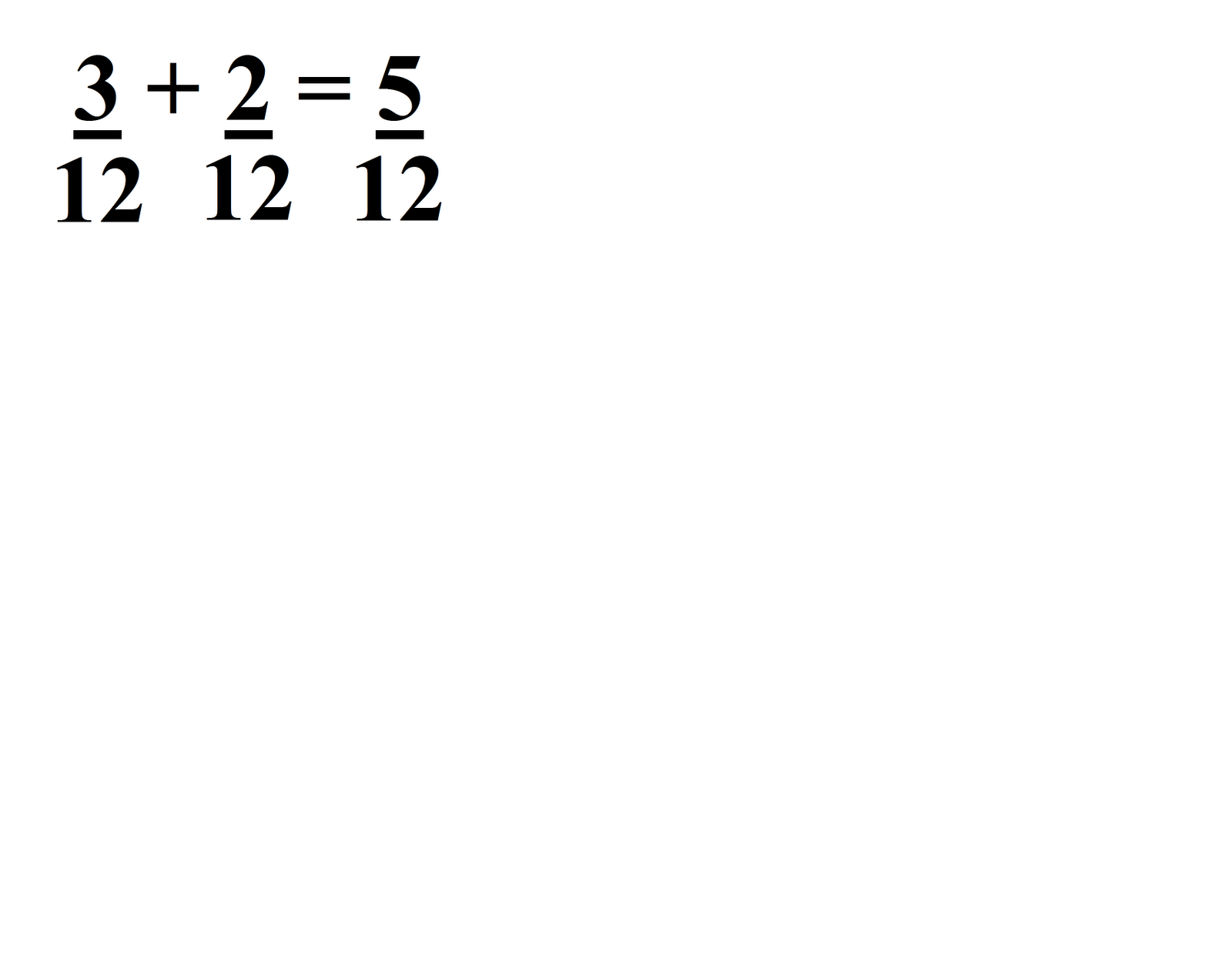
Then you make it into it's simplest form but you can't make 5/12 simpler.
So this is how you add fractions with unlike denominators.
Tuesday, December 6, 2011
Textbook Page 121
8) Subtract. Write your answer in lowest terms.
D.

Always remember, when you are subtracting two fractions the numerator changes and the denominator always stays the same.
If you are still having trouble with subtracting fractions and making them into lowest terms then here is a link that might help you.
If this link still doesn't help you then here is a video that might be easier to understand.
Hope this helped you with subtracting fractions and making them into lowest terms!
D.

Always remember, when you are subtracting two fractions the numerator changes and the denominator always stays the same.
If you are still having trouble with subtracting fractions and making them into lowest terms then here is a link that might help you.
If this link still doesn't help you then here is a video that might be easier to understand.
Hope this helped you with subtracting fractions and making them into lowest terms!
Monday, December 5, 2011
Divisibility Rule For 9
Rule for 9 - The sum of the digits is divisible by 9.
1) You have a number.
eg. 1897236
2) You add them all together.
eg.

3) If you don't know if 36 is divisible by 9 then you take 36 and add them to make 3+6.
eg.

4) Now is 9 divisible by 9? Yes.
S0 1897236 is divisible by 9.
Now let's do another one.
37836547
Now use the steps.
So first you add them all together.
3+7+8+3+6+5+4+7=43
Now if you don't know if 43 is divisible by 9 then you add them together again.
4+3=7
7 is not divisible by 9. So 37836547 is not divisible by 9.
If you are still having trouble then here is a link that might help you.
1) You have a number.
eg. 1897236
2) You add them all together.
eg.

3) If you don't know if 36 is divisible by 9 then you take 36 and add them to make 3+6.
eg.

4) Now is 9 divisible by 9? Yes.
S0 1897236 is divisible by 9.
Now let's do another one.
37836547
Now use the steps.
So first you add them all together.
3+7+8+3+6+5+4+7=43
Now if you don't know if 43 is divisible by 9 then you add them together again.
4+3=7
7 is not divisible by 9. So 37836547 is not divisible by 9.
If you are still having trouble then here is a link that might help you.
If this link doesn't help you then try this video that might work better.
Hope this helped you if you were still having trouble finding out if a number is divisible by 9.
Tuesday, November 15, 2011
Chapter 4 Review Test
Question #4 on page 146 in the textbook.
B. Find 25% of 84.
Use a ratio table to find the answer.

So the answer to finding 25% of 84 is 21.
Also, always remember whatever you do to one side, you have to do to the other side.
B. Find 25% of 84.
Use a ratio table to find the answer.

So the answer to finding 25% of 84 is 21.
Also, always remember whatever you do to one side, you have to do to the other side.
Monday, October 31, 2011
Order of Operations

Step 1: Any Brackets, no
Step 2: Any Exponents, no
Step 3: Any multiplication or division, Yes so you go from left to right.
Step 4: Any addition or subtraction, Yes there is addition so you do the addition.
Here is a link to help you even more with BEDMAS :
Subscribe to:
Posts (Atom)